

Are Emotions Constructed?
A review of How Emotions Are Made by Lisa Feldman Barrett

What is an emotion? It seems like it should be obvious, but here is the opening of a paper titled, fittingly enough, “What is emotion?”:
There is no consensus in the literature on a definition of emotion. The term is taken for granted in itself and, most often, emotion is defined with reference to a list: anger, disgust, fear, joy, sadness, and surprise.
Well, darn. But at least we still have the list of emotions, right? And I learned, in my Psych 101 class, that emotions are universal. In every culture, people make the same faces and can recognize those faces as belonging to certain emotions.
Except… apparently that isn’t right. Or at least, many emotion researchers have questioned it, including Lisa Feldman Barrett, a huge figure in the field of emotion research (and author of How Emotions Are Made, the book this post is about).
The usual studies mustered in favor of universal emotions are a series of classic experiments from the 1970s, primarily by Paul Ekman. Ekman argues there are seven basic emotions shared by all human cultures.
Each emotion comes with a universally recognized facial expression.
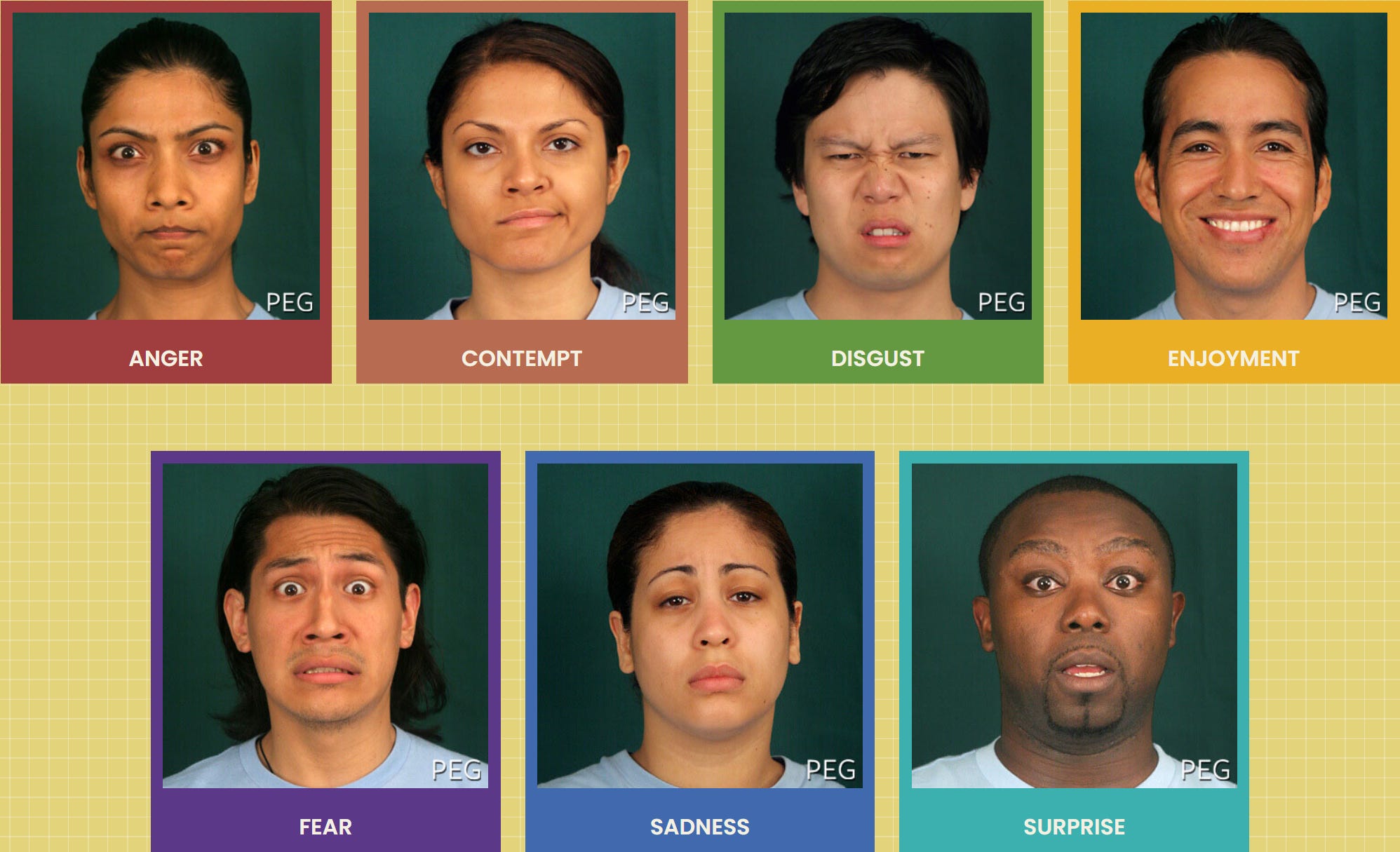
Ekman’s studies took images like the above, of actors expressing an emotion, and brought them to remote tribes thought to be uninfluenced by the global culture. Even members of these societies could identify the emotions of the actors based on the facial expressions, presumably showing the universality of emotions.
That’s where the story ended in my Psych 101 class, and I had pretty much taken it for granted since that emotions were these more-or-less discrete things we can attribute to our universal human nature.
It turns out there’s been lots more research since those initial studies.
The initial experiments all used fairly constrained task designs—participants were shown some faces, and either asked which face was associated with a specific emotion, or asked to pick from one of a few emotions to label a specific face. For pre-literate societies, they would tell a story and then were asked to choose the face that went with the story.
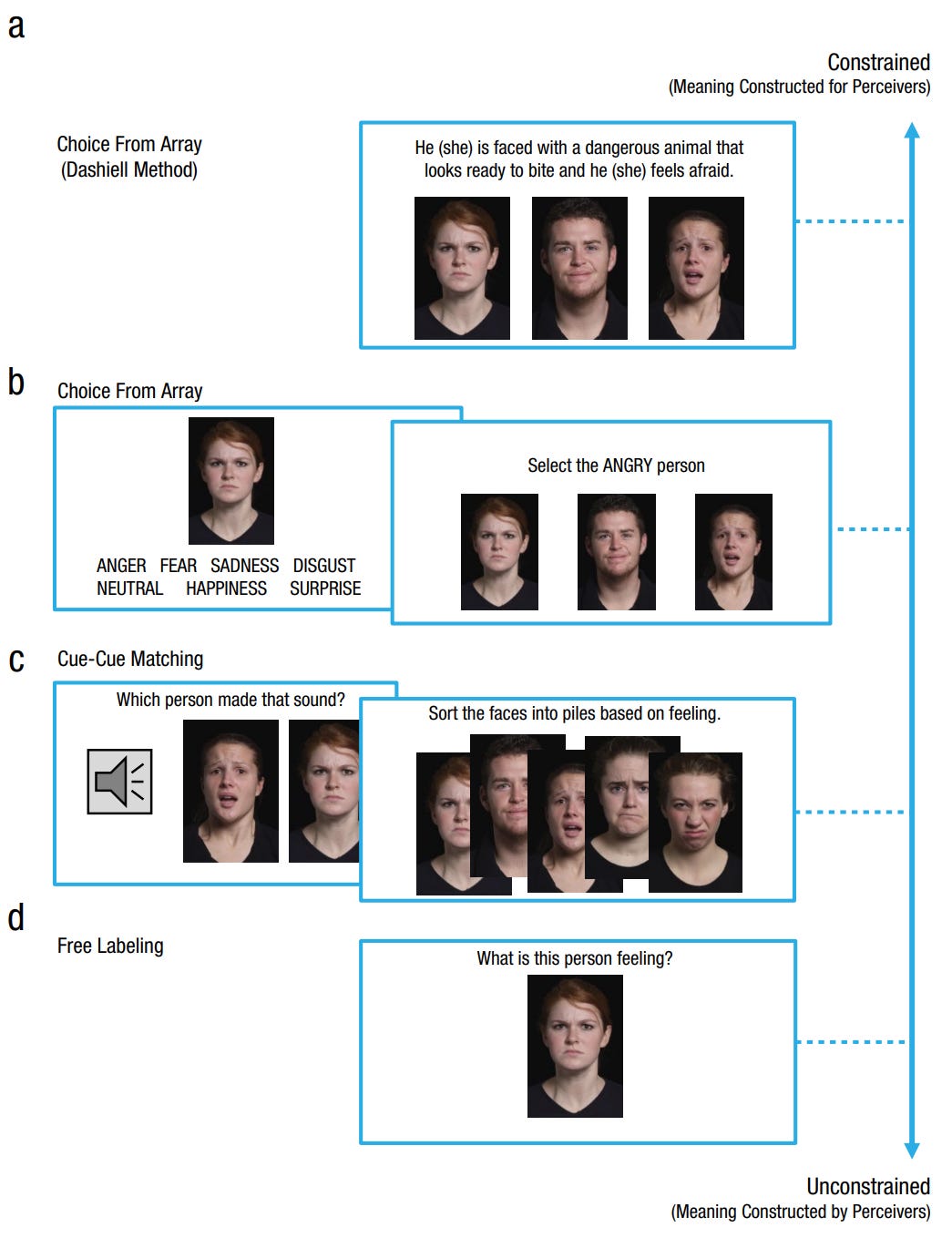
There are issues with these constrained methodologies. For one thing, participants can use the process of elimination based on emotion words seen in previous trials, artificially inflating label agreement. Participants might pick up on affect instead of emotion—some of the faces are more intense, and so presumably show a stronger feeling, allowing participants to eliminate many of the options without recognizing the specific emotion. Finally, there are concerns that performing the experiment actually involves introducing emotion concepts, rather than unearthing the ones already present.
These methodological concerns have led to studies using less constrained methods, like just showing a face and asking the participant to label the emotion. Then you get much less agreement, calling into question the basis of this idea of universality of emotions.
Lisa Feldman Barrett puts this classic view of emotion up as the main antagonist in her book. She systematically goes through the argument for emotions as basic, and calls into question a lot of the assumptions: there don’t seem to be emotional “fingerprints” anywhere you look. Although you can have actors make the exaggerated prototypical face to go with emotions, out of context it becomes much harder to judge a true emotional expression based on face alone.
Imagine the woman in the picture below was just told a funny joke. What emotion is her face showing?

Now, imagine she is about to have blood drawn and the needle is about to go in. What emotion is her face showing?
Hopefully this worked and it seems genuinely ambiguous. Barrett argues that this ambiguity about facial expressions goes for any other fingerprint of emotion you might try to find. Our body’s physiological responses can vary widely despite us feeling the same emotion, and there aren’t brain regions that respond specifically and consistently to emotion categories.
Thus, Barrett argues, not only are emotions not universal, they are also not basic. There’s no simple one-to-one correspondence between any physiological measure and emotion. There isn’t an emotional fingerprint that seems built into our biology. Instead, there’s variability and context-dependency.
What, then, is the alternative to emotions being built-in, discrete, and basic?
Dimensions of Affect and Constructed Emotions
Barrett argues that the reason there is no biological fingerprint for emotions is that emotions are constructed. They are more conceptual and social than basic biology.
This might seem hard to swallow. It might feel like Barrett is saying emotions aren’t real. That’s not quite right—she has, after all, written a paper titled “Emotions are real“. Regardless, it might feel like a big leap from our immediate, visceral experiences of emotion, to the idea that these are in any way “constructions”.
I’m going to do my best to defend Barrett’s theory here (as I understand it). I’m not sure how much I buy the full story, but thinking about it has definitely enriched my conception of emotion, and the full story is less sensational than you might think from the headline “Emotions are constructed”.
The biggest step towards making this idea more palatable is the distinction between emotions and affect. Affect, according to Barrett, is a basic aspect of our experience. Barrett adopts a common model of affect, where there are two dimensions: activation (deactivated to activated1), and valence (negative to positive). You can feel positive and high activation, which we would describe as excited, or negative and activated, which would be feeling stressed or tense. Deactivated and positive would be relaxed, while deactivated and negative would be lethargic or depressed.
Wait a minute, you might say, all of those sound like emotions to me! And yeah, this is where the idea of constructed emotions gets deflated quite a bit in my opinion.
If you look back up at Ekman’s list of universal emotions, there’s only seven. Where does feeling relaxed or serene come in? Do they fall under enjoyment? Is that the same emotion as excitedly happy? These certainly seem like radically different feelings to me, but are they different emotions?
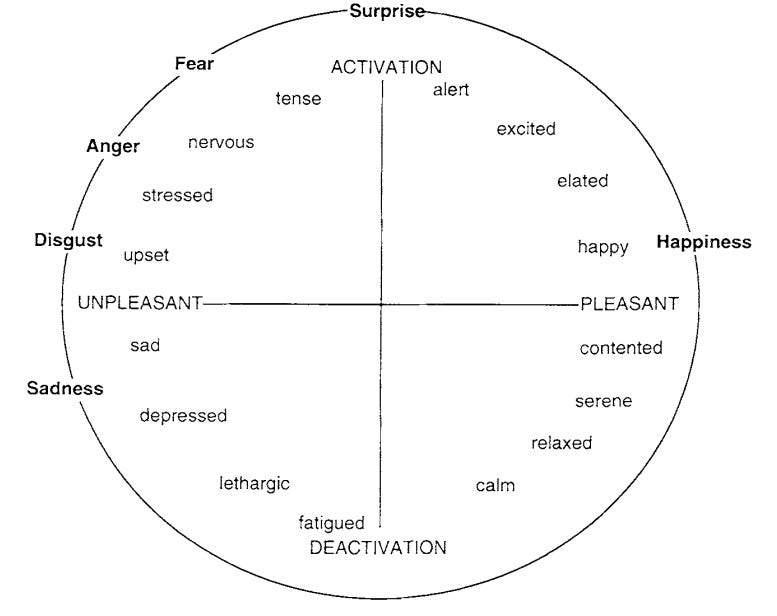
This all comes down to the definition of emotion, which, going back to the quote I started this article with, there’s a frustrating lack of consensus on.
Here’s Barrett’s attempt at a definition of emotion:
A prototypical emotional episode is a complex set of interrelated subevents concerned with a specific object. The object is the person, condition, event, or thing (real or imagined; past, present, or future) that the emotional episode is about—one is afraid of, is angry with, is in love with, or has pity for something. Prototypical emotional episodes necessarily include all of the following: core affect (to be defined shortly); overt behavior of the right sort (flight with fear, fight with anger, etc.) in relation to the object; attention toward, appraisal of, and attributions to that object; the experience of oneself as having a specific emotion
Here’s an example (from the same paper) to help with the distinction:
Consider the word happy. On receiving a gift, Sally feels happy, smiles, and hugs the person who gave her the gift. Another time, Sally feels happy for no known reason. The first case would be a prototypical emotional episode, the second not. Both involve core affect.
This seems like an odd division to me, in the sense that I would describe myself as feeling the emotion of happiness even if I don’t know why I feel that way.
But I think this is fine for Barrett’s theory—if emotions are concepts, they’re categories we’ve made, and categories often have cases that don’t quite fit any rigid definitional pattern.
According to Barrett, emotions help us make sense of our reactions to things (by giving us an easy label to understand ourselves and communicate it to others), and prescribe action. It goes beyond the mere affect feeling, but is the broader conceptual category that combines the affect, contextual factors, and goals.
For example, “anger” is a state of high activation and negativity. What makes it different from a feeling of being “upset”? Anger tends to have a direction—we get mad at something. There’s a reason for the feeling (which helps us make sense of what’s going on) and the experience is bound up with a goal, like “hurt the person/thing”. These go beyond mere affect, and bring in extra dimensions to go from “upset” to “angry”.
These “extra dimensions”, then, are the emotional concept. According to Barrett, they are patterns that we learn from observing ourselves and others.
Emotions, in this view, are far more flexible than the basic emotion theory would credit them. Many of us have learned terms from other languages—like schadenfreude, the experience of pleasure derived from someone else’s misfortune. Or, one I recently learned, gigil, a word from Tagalog (a major language native to the Philippines) that means “an overwhelming urge to squeeze, bite, or pinch something unbearably cute or incredibly frustrating”. Some refer to this as cute aggression.
The idea that emotions are constructed isn’t to say they’re arbitrary or illusory. Instead, it’s that a basic affective response and the context it’s happening in is recognized and categorized by a learned concept that tells us what it’s about and what it’s for. The concept is capturing a real pattern in your internal state and goals.
All of this categorization happens without our conscious awareness. If you look around your room you’ll see objects like books, computers, and the bathroom ceiling fan you’ve been meaning to install (I might be universalizing from my experience here). Without conscious effort, the visual signals from your retina are being classified based on concepts you’ve learned, turning the visual input into categories. Emotion, in this view, works the same way: you recognize anger based on the signals coming from your own body and the context they’re happening in.
Do we need a concept to experience something?
One of the more provocative claims in the book (other than the central claim that emotions are constructed) is that we need to have the concept of an emotion to experience that emotion. Is this true? It seems hard to swallow, but then so did the whole constructed emotion thing before I took the time to really dig into it.
This book has generated the most discussion of any previously in the book club, and I benefited enormously from being forced to think through the criticisms and thoughts people had about it. Thanks especially to Behavioral Logic, alfinpogform, Joe Shirley, Eric Borg, and Joseph Rahi.
The remainder of this post is a bonus for paid subscribers. If you want to support Cognitive Wonderland and/or join the Discord community and get access to paywalled content, consider becoming a paid subscriber.
