

Blinded by Blindsight
Can you see without being aware? The condition "Blindsight" is often reported to show we can, but it isn't as simple as it's often portrayed

“Seeing without Knowing it” is the provocative title of a Scientific American blog post. They go on to clarify they don’t mean a subliminal flash in a movie:
But what about seeing something when you think you are totally blind? What about navigating around obstacles that you cannot see and aren’t even expecting?
The article is talking about blindsight, a condition where people who have sustained brain damage to the visual areas of the brain report being blind, but can still respond to some visual stimulus. For example, they can tell whether an image is being presented or not, whether it’s on the left or the right, or if it’s horizontal versus vertical stripes—all while reporting they don’t see anything. In one dramatic demonstration, a blindsighted man walking down a hallway navigated around objects in his path.
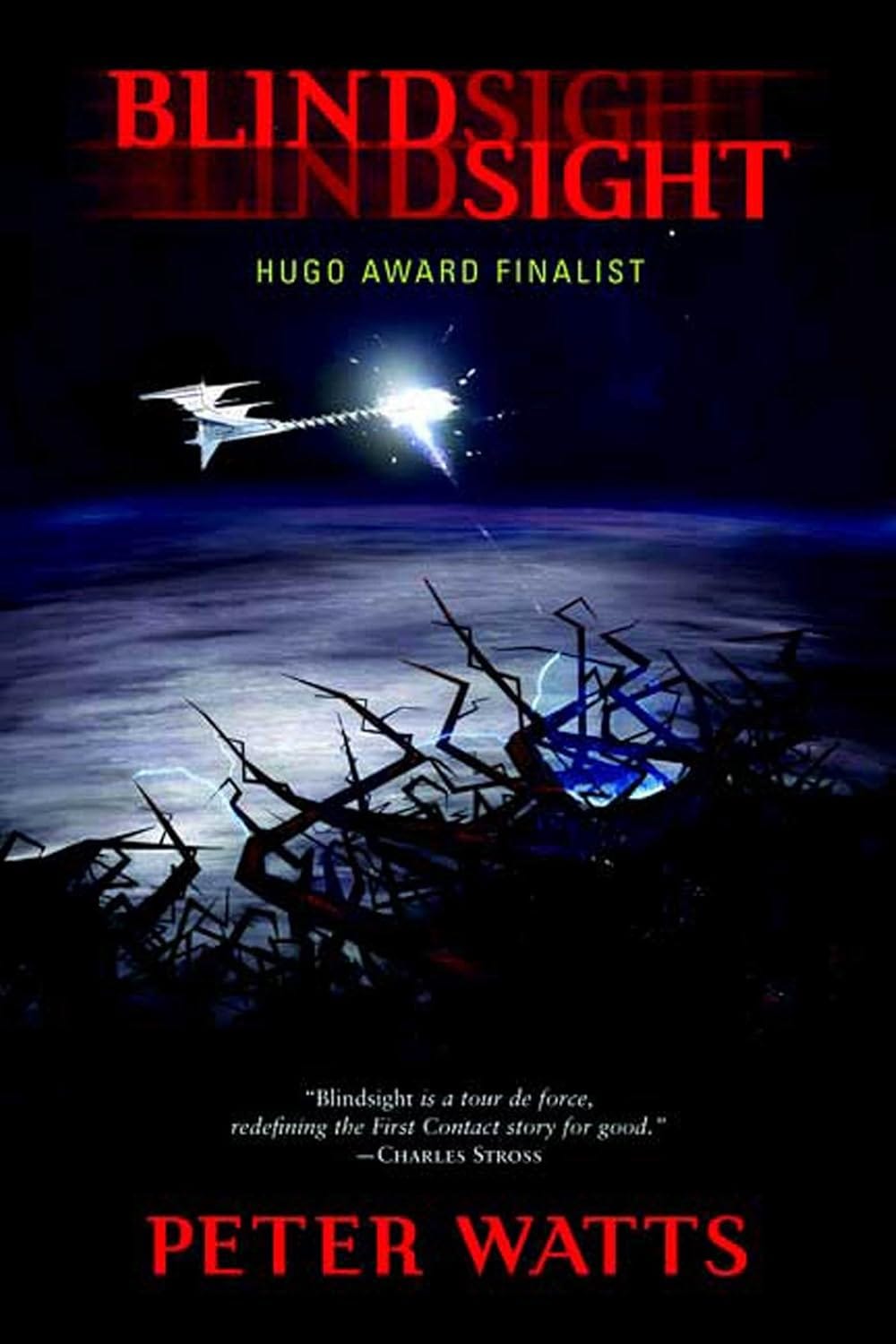
Because blindsight is purported to be a dissociation between conscious awareness and visual ability, it’s captured imaginations, being featured in many philosophical debates. It even inspired a science fiction novel, where author Peter Watts was inspired to create aliens who are not conscious but still act intelligently. Fittingly enough, the novel is titled Blindsight.
I’ve long been aware of blindsight, and generally accepted the story that it’s a case of dramatic dissociation between awareness and sight. I’ve pointed to it often as an example of “one of those weird neuroscience cases that tell us something about consciousness”.
However, I had never read the literature on blindsight until recently, and it was a bit of a surprise that I came away skeptical that it’s anywhere near as special as it’s sometimes reported to be.
What is blindsight?
Blindness comes in different forms. Most types involve some issue with the eye itself: Cataracts can cloud the eye’s lens, the blood vessels in the retina can be damaged, or the optic nerve that carries signals from the retina to the brain can be damaged.
Cortical blindness is different, it involves damage to the part of the brain that processes the visual information from the eye. The eye itself is fine, it’s the brain receiving the signal that isn’t working.
Two bombshell papers in 1973 and 1974 described experiments done with cortically blind patients who were able to do simple visual discriminations in the lab, despite reporting not being able to see anything. This was followed by decades of research on blindsight patients and intense debate about it and its implications.
The idea of us being able to take an action without consciousness is nothing new—reflexes exist, after all. What’s striking about blindsight is it involves discriminations that are normally conscious and can be acted on flexibly.
The initial reports of blindsight were met with skepticism, but it’s generally accepted now and appears in textbooks. Still, there’s significant controversy around it. A 2021 paper argued that blindsight is actually just “qualitatively degraded conscious vision”. This sounded ridiculous to me when I first came across the paper, but I now at least lean in the direction that it’s got things right.
Discrimination Without Awareness
It might seem crazy to say that blindsight is just degraded conscious vision. The patients report not seeing! Their vision is clearly not conscious!
To get a bit of a handle on why this isn’t that unreasonable, we need to go into the world of psychophysics, which is my favorite name for a subfield because it sounds like it’s straight out of a science fiction novel. Psychophysics is the study of the relationship between physical stimuli and their perceptions. A canonical type of experiment is finding the threshold at which a stimulus can be detected. For example, how little light can you use before someone no longer detects it? Or how much of a brightness difference does there need to be between two lights for someone to notice the difference?
One common kind of stimulus used in psychophysics (and vision research more broadly) is the Gabor patch: a patch of oriented, repeated bars that fade out around the edges. Psychophysicists can alter the properties of the patch to see how it impacts how well we can detect it. For example, you can lower the contrast—see the example below, where on the right is a high contrast Gabor patch and on the left is a very low contrast one.
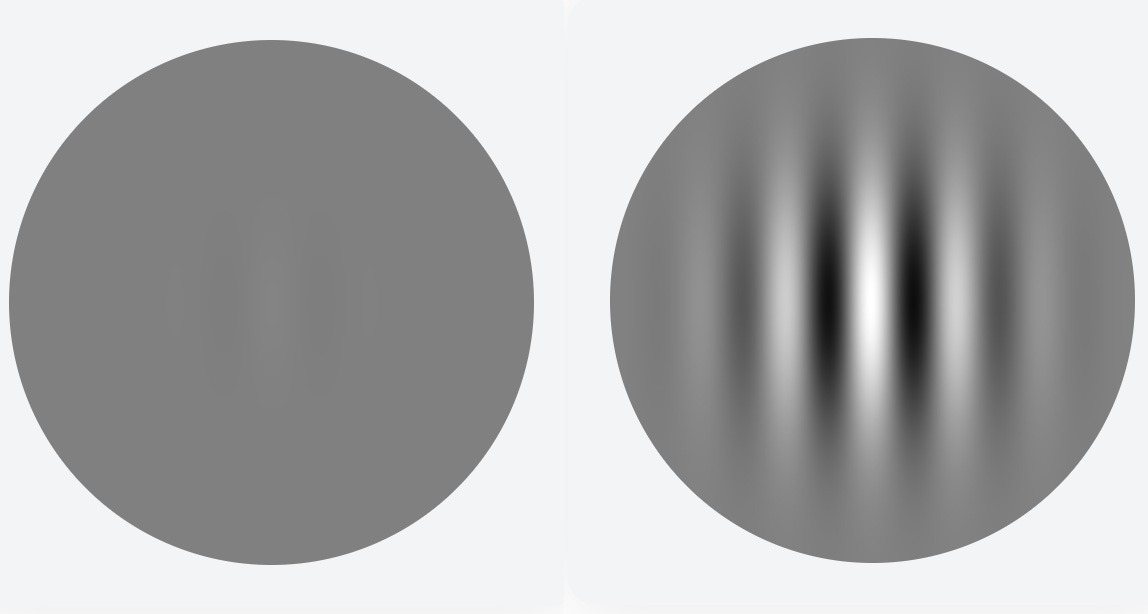
You can play around with the properties of Gabor patches yourself here. I generated the left one by testing how low I could put the contrast to feel like I’m just at the edge of what I detect. On my screen, in my particular lighting, I can somewhat reliably see that the left isn’t just a grey circle, but other times I feel like maybe it’s my eyes playing tricks on me.
Blindsighted individuals aren’t making discriminations that are that subtle. If the discriminations they make in lab tasks were conscious, they would still be well below the threshold of legal blindness. Here’s the sort of discrimination they would struggle with: high contrast bars that are either horizontal or vertical. When asked “is it horizontal or vertical?” they might get it right 60-70% of the time.
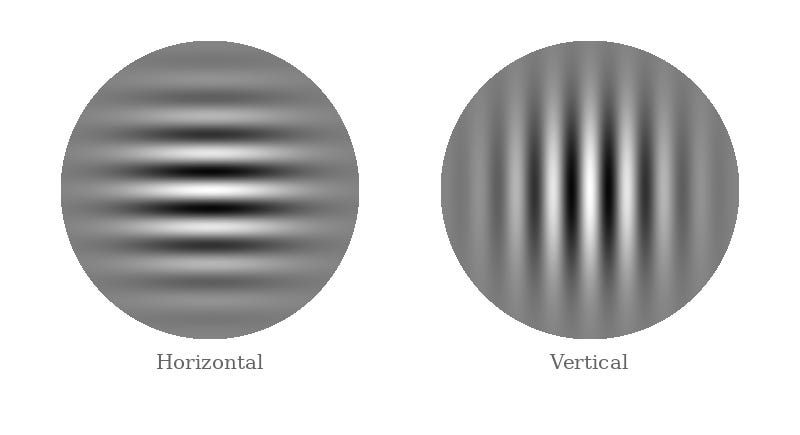
Now to get a sense for how psychophysics experiments work, imagine being shown, possibly around 100 times, different Gabor patches around the threshold of what you can see, and being asked their orientation. Then, separately, you rate whether you saw it or not. It’s not hard for me to imagine that, on many trials around my threshold, I might have the “eyes playing tricks on me” feeling, and respond that I didn’t see it.
In “signal processing theory” terms, what I’m describing is called a conservative detection criterion—my ability to make discriminations outstrips my willingness to report my awareness. Research indicates it’s common for people to have a conservative detection criterion when they’re at the edge of their ability to discriminate. That is basically the deflationary case against blindsight—that it’s basically the same experience as anyone who is dealing with a stimulus right at the threshold of what they can detect.
You can see the association between their “detection sensitivity” (how well someone is discriminating things) and their “detection criterion” (how willing they are to report awareness) in the figure below. As detection sensitivity goes up (as we move to the right), detection criterion tends to go down. When a task is easier, we’re more willing to say we’re aware.
The red point is a blindsight subject, the other points are normal healthy people performing a difficult discrimination task.
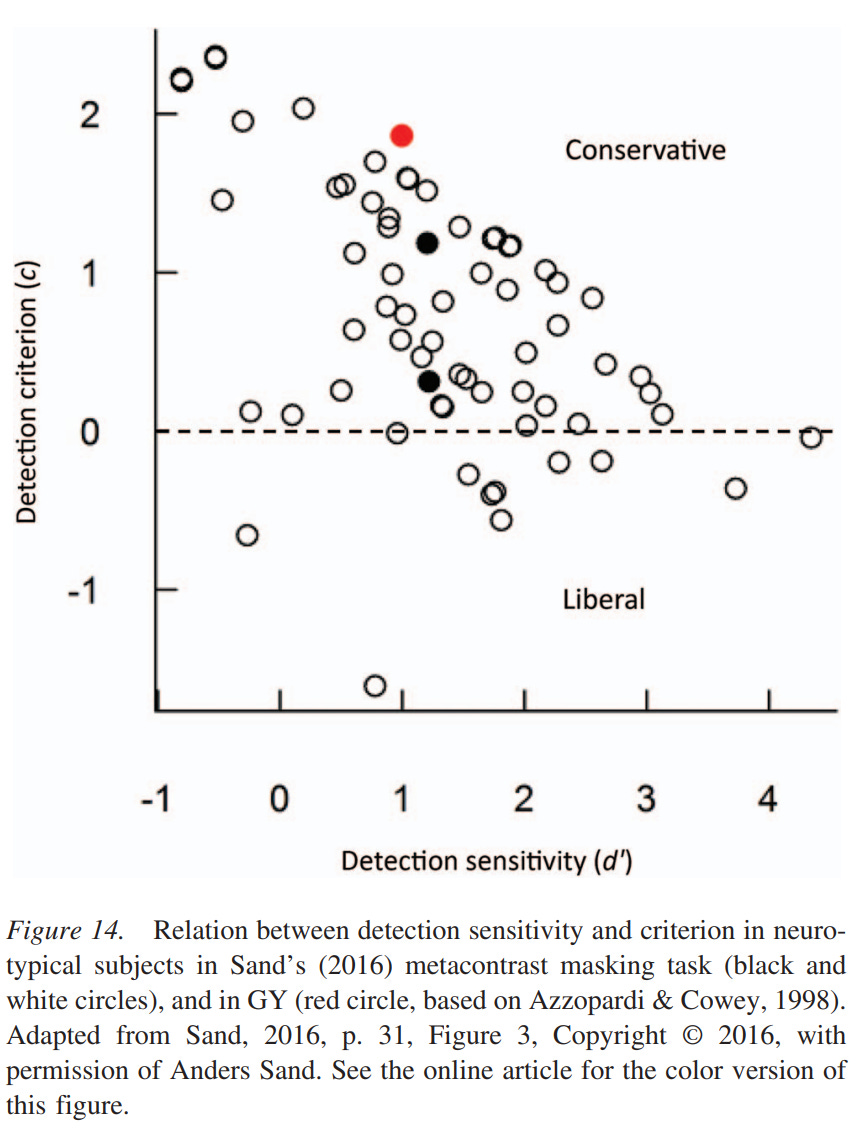
The point is that the red dot here doesn’t stand out that much. It’s slightly above the others, indicating a slightly higher conservativeness than you would expect, but it’s not a crazy outlier.
Simple factors could explain why blindsight folks are more conservative—for example, since many of them have vision in parts of their visual field (or previously had vision before the injury that led to their condition), they might be comparing “seeing” to that vivid visual experience and acknowledging they don’t have it.
This is the kind of grey area blindsight studies are sitting in. It isn’t a patient stating clearly “I see nothing” but then being able to detect the stimulus perfectly 100% of the time. It’s being at the edge of what they can detect, and then showing they detect something fairly well despite reporting not being able to see it. That’s when subtle things like how you ask a question start to matter.
It Matters How You Ask The Question
Is there a difference between asking someone “Did you see something?” versus “Were you aware of something?” In everyday life, those seem pretty similar—usually we’re dealing with clear, vivid sights, so seeing something implies you are aware of it and vice-versa. But it turns out subtle differences like this can elicit very different effects.
The below figure was generated during a test of peripheral vision in a blindsighted person. The white circles indicate where the person gave a positive response, the black (you can’t really tell but they’re also circles) when they gave a negative response. Only the right visual field is tested, which is why there are no circles on the left.
The difference between a and b is simply phrasing: a is “Did you see something?” and b is “Were you aware of something?”
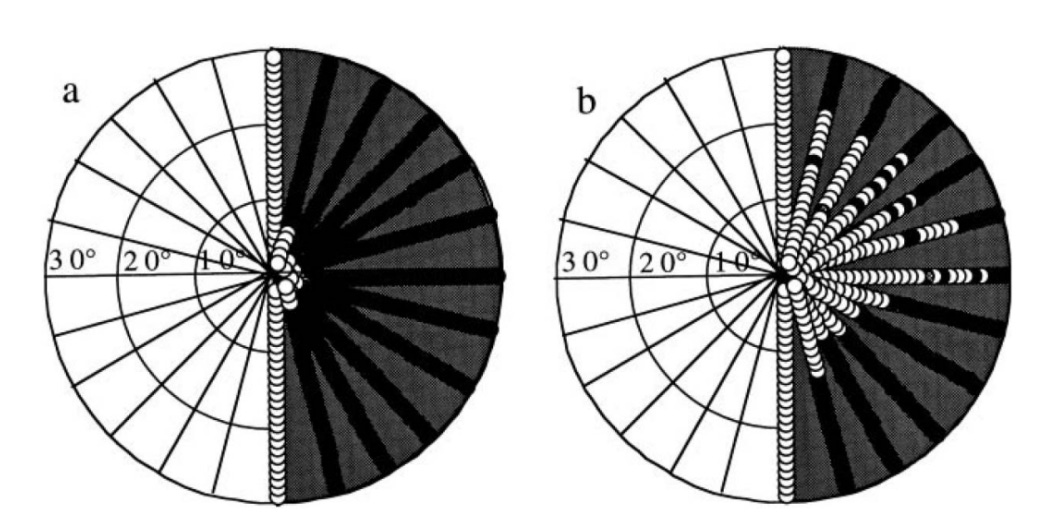
Clearly, the threshold for when this person says they are “seeing” something is higher than when they say they are “aware” of it. If what they’re aware of is vague, they might be willing to say they are aware of something but don’t see it.
In a typical blindsight study, participants are given two possible responses, was the stimulus seen or unseen. But a couple of studies have now tried asking on a more graded scale, the 4-point Perceptual Awareness Scale: no experience, weak experience, almost clear experience, and clear experience. In one study involving a blindsighted woman, using the traditional “yes-no” question evoked the usual blindsight result (above-chance detection when reporting “no” for seeing). But when they switched to the 4-point scale, she was at chance for “no experience” and only above chance for “weak experience”.
In other words, it seems she was lumping “weak experience” in with “no awareness” when she was only given two options. Which makes sense—there’s a big difference between very obvious awareness and the sort of “my eyes might be playing tricks on me” awareness that sometimes happens at the threshold of what we can detect. It seems “awareness” comes in degrees.
There’s long been a distinction between “Type I” and “Type II” blindsight, where Type I is the kind you typically see mentioned (detection with no awareness) and Type II involving detection with some awareness. This already makes blindsight a bit more of a gradient than is often acknowledged, but interestingly, with training, some people both increase their ability to detect and their awareness, going from Type I to Type II, and some eventual full visual experiences.
I don’t want to give the impression that these simple measures mean the issue is clear-cut and, actually, if you change the way you ask a question, it completely undermines the effect. Blindsight patients are rare, and while there has been a lot of research on them, they tend to be on very few subjects (often one), and methodologies are varied. But the important point is that in the popular imagination, blindsighted people are described as having absolutely no visual experience, whereas the reality seems to be that they often have some, and the line between seeing and not seeing isn’t as clear as you might think.
What is it like to have blindsight?
The picture I get from reading about the above research is that blindsight is much less like a reflex, where there’s no awareness, and much more like seeing in a dense fog. But that doesn’t quite get at it, because the kind of awareness blindsighted folks have is different from typical vision.
First, as mentioned above, the kind of discriminations they’re making are not good. The typical blindsight result is that they can tell apart big, obvious stimuli at somewhat above chance levels.
It’s been suggested that while some low-level features can be detected by blindsighted people, they can’t combine those elements into forms and objects. So it isn’t like seeing shapes in a fog, but more like being able to dimly sense the different components of a shape but not seeing how they come together.
It’s typically reported that blindsighted folks can’t see or discriminate color at all, but a recent case study reported a patient who could. It involved him needing to pick up and move an object around in front of his eyes for a bit, and then suddenly he would declare “It’s red!” You can see the videos here or read the full case report, it’s interesting. He describes it as the color popping out and stinging his eyes, and then it seems obvious.
I imagine it’s a bit like seeing an object in the dark, not quite being able to make out what it is, and then once you know what it is, it becomes obvious. It is odd to think of having this kind of perception with something as basic as color, since that usually jumps out at us so easily.
There are plenty of descriptions from blindsighted people describing their experiences. They tend to emphasize some vague awareness without quite knowing what they’re aware of, for example: “I had an impression that something was there. Where it was made a greater impression than what it was.” One individual described it as like the experience “of a normal person when, with the eyes shut, he looks out of the window and moves his hand in front of his eyes . . . like a ‘shadow’” or “a black shadow moving on a black background”.
So the picture I get of all of this is that sensing even the most basic visual elements is at the edge of their abilities, and combining them into “things” isn’t possible.
For us sighted folks, vision is very “all or nothing”. We get incredibly rich information through sight, or we close our eyes and get nothing. Part of what’s so captivating about blindsight is thinking about it as just as detailed as our normal, vivid sight, but without awareness. But the better image might be vague shadows seen through a foggy glass. Different aspects are distorted, can’t be put together into a full image, but you get occasional senses of something.
Is Blindsight Just Degraded Normal Sight?
I don’t want to give the impression that all of this is settled and it’s obvious that blindsight isn’t anything special. There are ongoing debates about all this. I’ve been drawing a lot on Ian Phillips’s paper in writing this, but there are other researchers who have written responses to his arguments (to which Phillips has replied).
The gist of the debate is that, even if in some cases blindsighted folks are aware, there seem to be others where they aren’t. The debate gets technical over how well Phillips’s arguments cover all the different cases.
All that said, when I read the empirical papers and the comments debating the issue, I find myself siding much more with the deflationary accounts. Blindsight seems special in the sense that it’s very particular degradations of vision that are worth studying, but I think this tells us more about vision than awareness/consciousness. It doesn’t seem to me like anywhere near as clean a dissociation between detection and awareness as you would want if you wanted to make big claims about different conscious versus unconscious processing.
It’s interesting comparing blindsight to something like a reflex. Reflexes also involve sensing something (like a hot stove) and taking action based on it without conscious awareness. What supposedly made blindsight special is that the action taken can be flexible—you can use that discriminatory ability to take arbitrary actions like, if you see something, “hit the button” or “raise your hand”. Reflexes lack that sort of flexibility. But the above story makes it seem like, to the extent that information is there and available to be acted on flexibly, it also becomes aware.
While the popular depiction of blindsight as a clear visual discriminatory ability without awareness might make great fuel for science fiction and thought experiments, the reality is less striking. But to the extent that blindsight isn’t special, thinking about perceptions at the edge of our awareness can be a good exercise. Our awareness can be vague and uncertain, unclear whether our “eyes are playing tricks on us”. There are many shades of grey in our visual experience, including whether we’re seeing a grey circle or a faint Gabor patch.
If you enjoyed this, please hit the “Like” ❤️ button, restack, or share this article to help others find it.
If you enjoy Cognitive Wonderland, consider supporting it by becoming a paid subscriber at whatever level feels comfortable for you.
If you’re a Substack writer and have been enjoying Cognitive Wonderland, consider adding it to your recommendations. I really appreciate the support.
"It is odd to think of having this kind of perception with something as basic as color, since that usually jumps out at us so easily."
We expect degraded vision to be on a spectrum of less clear or bright since that's what we experience when our eyes degrade or are obscured.
But when talking about problems with the brain rather than eyes, I suppose problems should be much odder!
Interesting. I think we are all blindsighted to some degree. Sometimes I drop something, a pen, a paper clip, a nail. I know it's down there but I can't see it. Until it leaps into awareness. I've scanned the same area a dozen times without "seeing" it. Until it leaps out at me. Same scenario with stuff in the pantry. Looking for a can of tomato soup amongst all the other cans of soup or other stuff. Nothing, nothing, nothing, until there it is. Sometimes I can't find it at all and announce to the world "I can't find the ...", at which point someone shows up, finds it instantly, and delivers the ultimate put-down, " If it was a snake, it would have bitten you." As a child, my mother's favorite response to that scenario was "Look behind something." As always, Mom knows best.