


There’s a common idea that neuroscience disproves free will. If we know the mechanisms behind our decisions, it’s thought, then there’s no room for us to be the cause of our actions. More worryingly, there’s always brain activity that precedes conscious intentions (they can’t just pop out of nowhere), so there seems to be no causal role for our intentions to play. Our conscious intentions are just along for the ride, and we make up a story after the fact to paper over our lack of agency.
The trouble is, this thinking requires us to make ourselves very small. If you think your decisions or intentions arising from the organization of your brain means they haven’t arisen from you, you’re saying you don’t see the organization of your brain as you.
At the heart of this disagreement is two different conceptions of free will. One is the libertarian or incompatibilist notion: anything with a cause can’t be said to have been freely willed. Since things in the physical world have causes (or perhaps are random, as under some interpretations of quantum mechanics), this leaves out the possibility of us being “uncaused causers” of our actions. Incompatibilism gets its name from being incompatible with determinism, the idea that all events must have a preceding cause.
This notion of free will has long been criticized by philosophers. Physical or otherwise, it’s not clear what it would mean for me to cause without being caused, but also not be random. Surely, I want my decisions to have reasons, and those reasons are causes for my actions.
The other notion of free will is the compatibilist one: free will is the ability to do what we want and act without coercion or internal compulsion. It’s the ability to respond to reasons, so we act rationally in the face of warnings, threats, and promises. This conception is compatible with determinism—if we want to be acting based on reasons, it is a good thing if our actions have preceding causes. This is a fuzzier, harder to grasp notion than the “act without any causes” notion, but avoids the problems with the metaphysical idea of being an uncaused causer while allowing us to retain a robust sense of freedom that we care about.
The primary argument I typically see against compatibilist notions of free will is that they are “changing the subject”. This is essentially the argument Sam Harris makes, and I often see it echoed online.
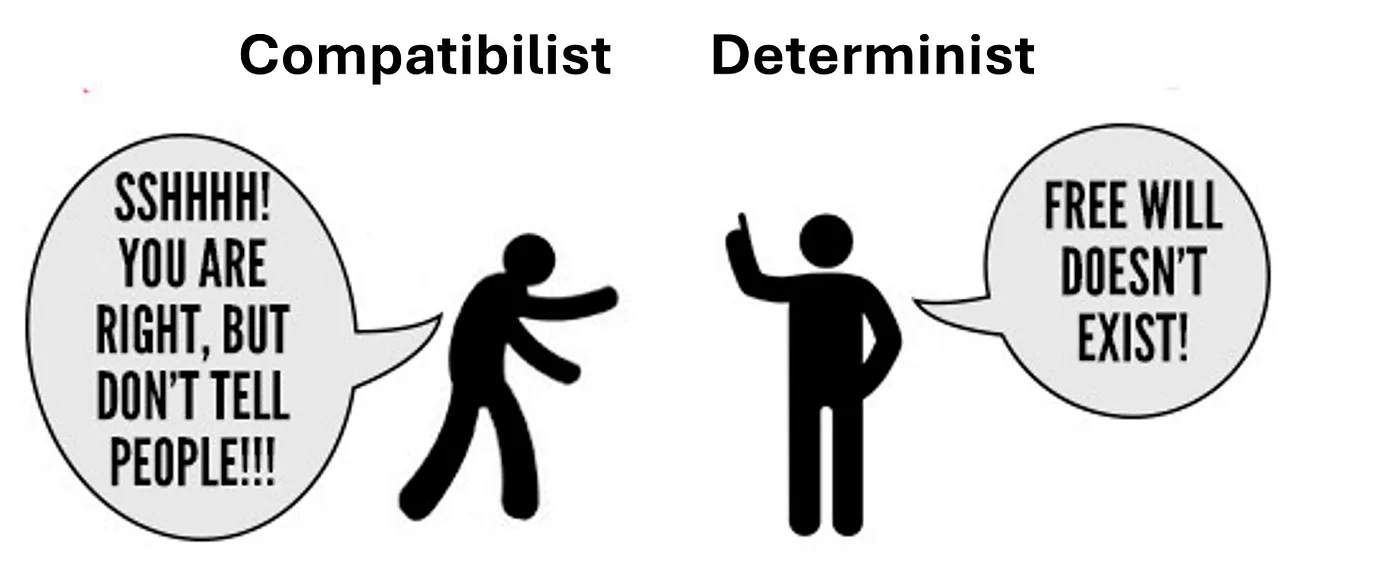
For compatibilists to be changing the subject, it would mean there must be agreement that the incompatibilist account is what most people are thinking when they mention free will. But it seems the non-expert’s concepts of free will and determinism aren’t particularly well-formed.
In some studies, people seem very compatibilist and say that even if everything is pre-determined, individuals still act with free will and are morally responsible. But this seems to depend on how concretely or abstractly scenarios are described. Lay people with incompatibilist leanings seem to mistake determinism for fatalism—that is, that determinism means beliefs and desires make no difference in what we do (instead of seeing beliefs and desires as part of a broader causal chain). This calls into question whether people quite get what this whole determinism thing is about.
My take is that it isn’t just unclear what non-experts think about free will, but that they don’t have coherent stances on the specific determinism versus free will issue. It might just be that depending on how something is asked, we’re evoking certain judgments, not probing beliefs. You can’t get at whether someone thinks free will is compatible with determinism if they don’t get what determinism implies.
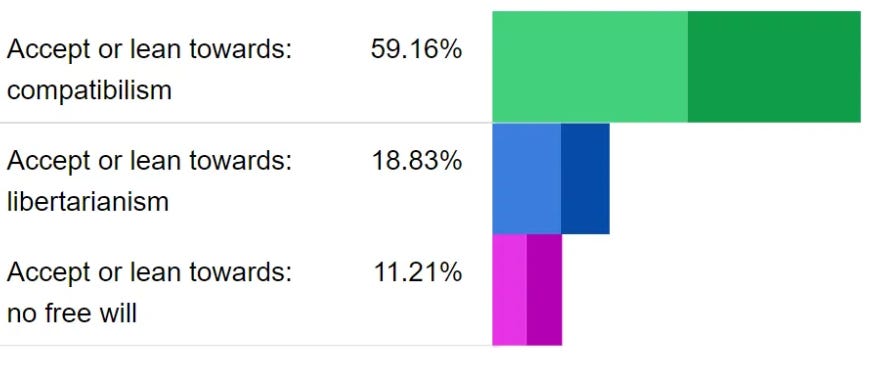
Another route to adjudicate what we mean by “free will” would be to look at what experts think. Maybe non-experts haven’t thought about the issue enough, so we should look to those who have thought about it a lot. When we look at the opinions of philosophers, it’s not just that compatibilism has strong representation, but it is the most common view by a longshot (59% accept or lean towards compatibilism).
I think folk concepts of free will are confused, but have the right contours. It’s correct to say we are the causes of our behavior, and it’s correct to think praise and blame (and reward and punishment) are justified—if someone is responsive to reasons, praise and blame give social incentives for people to act in ways that are collectively beneficial. Hard determinists like Robert Sapolsky or Gregg Caruso might reply that the folk concept is also tied up with notions like retribution, which is hard to justify, and therefore we should throw the concept out. The difference between the positions seems to be a judgment about where the weight of concerns around retribution and moral responsibility lands us.
For a layperson, though, I think all of this stuff about moral responsibility and metaphysics misses what gives the free will debate its real driving force. Sam Harris makes this point in his charge that compatibilists are changing the subject:
The popular, folk psychological sense of free will is a moment-to-moment experience
I don’t think this is strictly true—there are more components to the folk conception of free will than this—but it’s a good point. When I’ve seen regular folks reply to discussions of free will, they typically do so by talking about their experience of causing their actions. Even if we accept that, in a third-person way, we can be said to be the cause of our actions, this leaves an important phenomenological question: is the first-person feeling of being the author of our actions true?
The illusion of conscious will
Even if we accept everything I’ve written above about identifying with the brain mechanisms that cause our actions, it could be that our actual intentions aren’t causally connected with our actions. Unconscious brain activity actually causes our actions, and our conscious thoughts are downstream and we think they cause our actions based on a mistaken inference.
This is the argument of Daniel Wegner, author of a book titled The Illusion of Conscious Will. The main thrust of the argument comes from studies that show that, under certain conditions, we can be mistaken about our conscious thoughts or intentions having causal force.
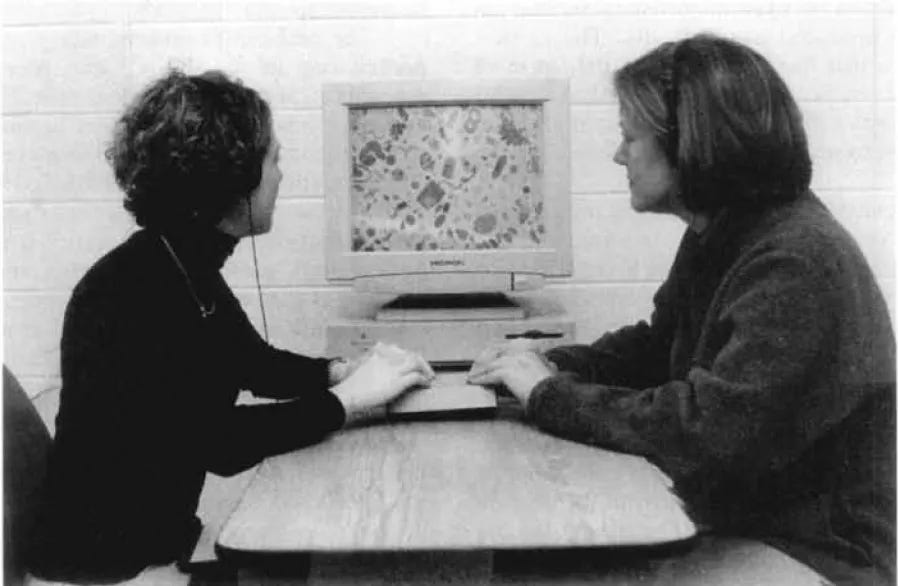
In one experiment, two people jointly slid a pointer across a screen of little pictures (imagine a Ouija board-like situation). One of them wore headphones that occasionally said the name of different objects pictured on the screen. If the participant heard the name of the object shortly before the pointer stopped on it, they were more likely to believe they were the cause of the stopping—even if the true cause was a pre-programmed computer. The headphones planted the relevant thought at the right moment, and that convinced the participant that they had made the pointer stop.
In another study in this vein, participants watched five circles and were told to quickly pick one in their head before one of them (chosen at random by the computer) turned red. When time was limited enough, people reported having chosen the dot that turned red at rates higher than chance. They thought they had made the decision prior to the dot turning red, but this can’t be right because the color change was influencing the decision.
With enough ambiguity or things happening quickly enough, we can be wrong about the causes of our decisions or actions.
According to Wegner, we attribute causality to our conscious thoughts when a thought comes before the action, the thought and action are consistent, and there aren’t obvious competing causes. That is, we infer (incorrectly, from Wegner’s view) that our thoughts have caused the action.
This is an interesting argument, because I agree that our feeling of conscious willing is an inference. Just because we took an action doesn’t mean we have full access to all of the reasons we did it. Brains are complex, and there are a lot of unconscious processes going on that we don’t have conscious access to, so the brain needs to make many inferences to make sense of what is self-caused and what is not.
Inferences don’t come for free
Scientists commonly talk about perception as a form of inference, where our visual system takes the ambiguous signals hitting the senses and has to infer what is “out there”. Emotion researcher Lisa Feldman Barrett even suggests that emotion is a form of inference, where we are categorizing our senses about our internal state. Neither of these feel like inferences, it’s not like we are aware of reasoning through evidence. The electrical signals in our retinas undergo processing, and we are only aware of the highly processed result—we see letters or words, not individual photons striking retinal cells. These inferences form a large part of how we experience the world, so it’s not a big leap to think that our experience of willing could also be an inference.
Even for something as simple as figuring out whether the movement of the image hitting our retina is due to us moving it or due to the world moving requires a sort of inference. When we look around, our brains create a copy of the motor signal sent to the eye muscles, and use that to “cancel out” the changes in the image sent. The brain is able to infer that the change in the image striking the retina is due to self-initiated action, not due to the world moving. This is an important difference—we wouldn’t want to be confused that an earthquake is happening every time we move our eyes.
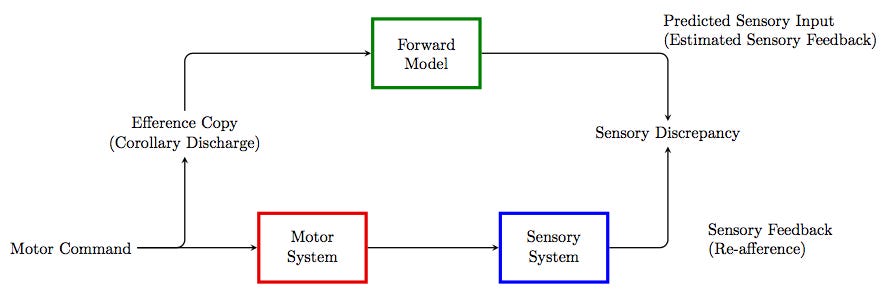
This is a fairly trivial inference, where we have the signal that causes the action directly tied to signalling that we were the ones that did it. But it’s a nice reminder that there needs to be an explicit mechanism tying action initiation to our knowing that we did it. These inferences don’t just come for free.
With more complex actions, we have more difficult inferences to make. With visual perception, our inferences are often wrong: out of the corner of my eye, I thought I saw a squirrel, but it turned out to be a bag blowing in the wind. Similarly, our inferences about having caused certain activities can be wrong.
One tragic example of this sort of error is facilitated communication. The noble idea of this technique is to allow non-verbal individuals, in particular those with autism, to communicate. A facilitator trained in the technique holds the arm of the non-verbal individual, while the non-verbal individual points to letters to spell out messages. The idea is that the non-verbal individuals could communicate, they just needed a bit of help.
Unfortunately, it turns out the non-verbal individuals were not the authors of the messages. If you show both the facilitator and the non-verbal individual the same image, they’re able to spell out what it was. If you show just the non-verbal individual the image, they can’t. If you show the facilitator and non-verbal individual different images, they spell out what the facilitator saw. In other words, the message is coming from the facilitator, not the non-verbal individual.
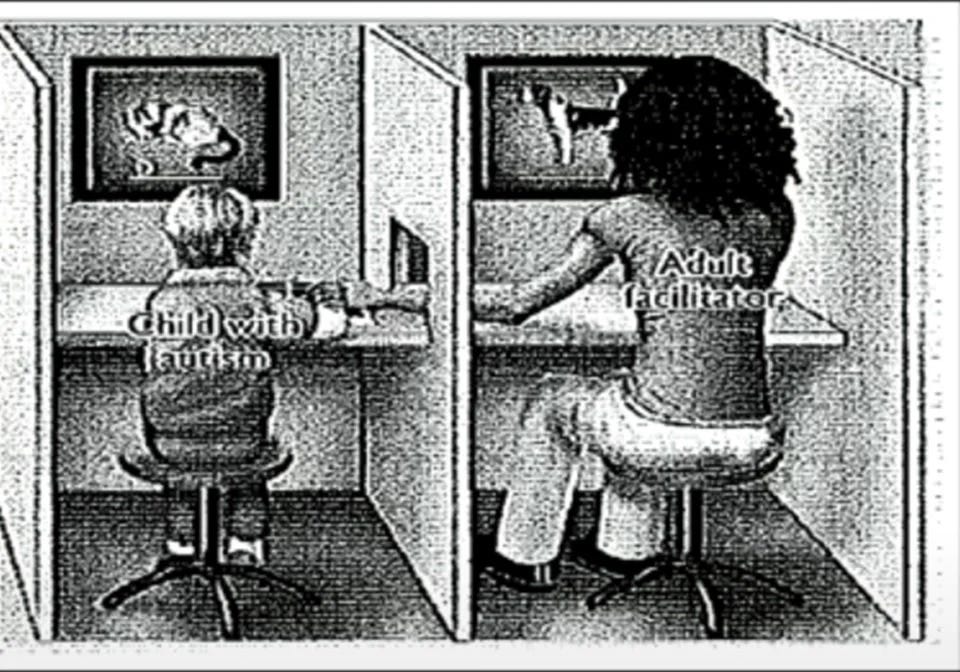
The thing is, the facilitators were (generally) unaware of this. They believed in their method and thought they were helping. They didn’t realize they were the source of something as complex as communication.
That’s a case of a false-positive, thinking you were not the source of an action when you were. The opposite can occur as well, where we think we are the source of something when we weren’t. It’s common to leave a team brainstorming session unclear on exactly who came up with the idea you eventually all agreed on. I’ve left those meetings and had multiple different people tell me they were the ones to come up with the idea. I’ve also had people tell me this marvelous idea they had come up with on their own, seemingly oblivious to the fact that I had told them this idea the week previous.
Mistaken causation within ourselves
It can also be difficult to infer the cause of an action, even when we’re sure the cause is within ourselves.
Why did I go to the kitchen to get an apple? Am I actually hungry, or was that just a way to avoid the hard cognitive work of figuring out how to phrase this sentence?
So going back to Wegner’s assertion that conscious willing is an illusion: it’s not surprising that, in laboratory conditions, we can create situations in which we get the attribution wrong. Sometimes our conscious intentions are not, in fact, our reasons for acting. This doesn’t imply they never are, though.
The psychology literature is replete with examples of the efficacy of our conscious thoughts: deliberate planning or forming the intention to do something affects our subsequent behavior. Consciously reasoning through a problem, or mentally framing a problem in a different way, all influence how we act. Mentally rehearsing sports or other motor skills improves performance, and mentally simulating another person’s perspective can help us harmonize better with them (or gain the upper hand in negotiations).
Our conscious intentions are not just “along for the ride”, and so at least some of the time, we’re correct that our actions stem from the intentions we are explicitly aware of.
The question, then, is how often this happens. How often do we have the illusion that a conscious intention caused something, but in reality there was a different cause? I don’t think it’s reasonable to say it’s 100% of the time, but it also isn’t 0%.
Some stories have far exaggerated the extent that we’re wrong about our reasons for our actions. If these stories were true, it certainly would make us question whether we act without compulsion, and would mean attributing our actions to conscious intentions would almost always be a mistake.
One famous study found that Israeli judges granted parole about 65% of the time at the start of the day, but the proportion fell to nearly 0% as lunch time approached. The authors concluded this was due to the judges, in effect, getting hangry.
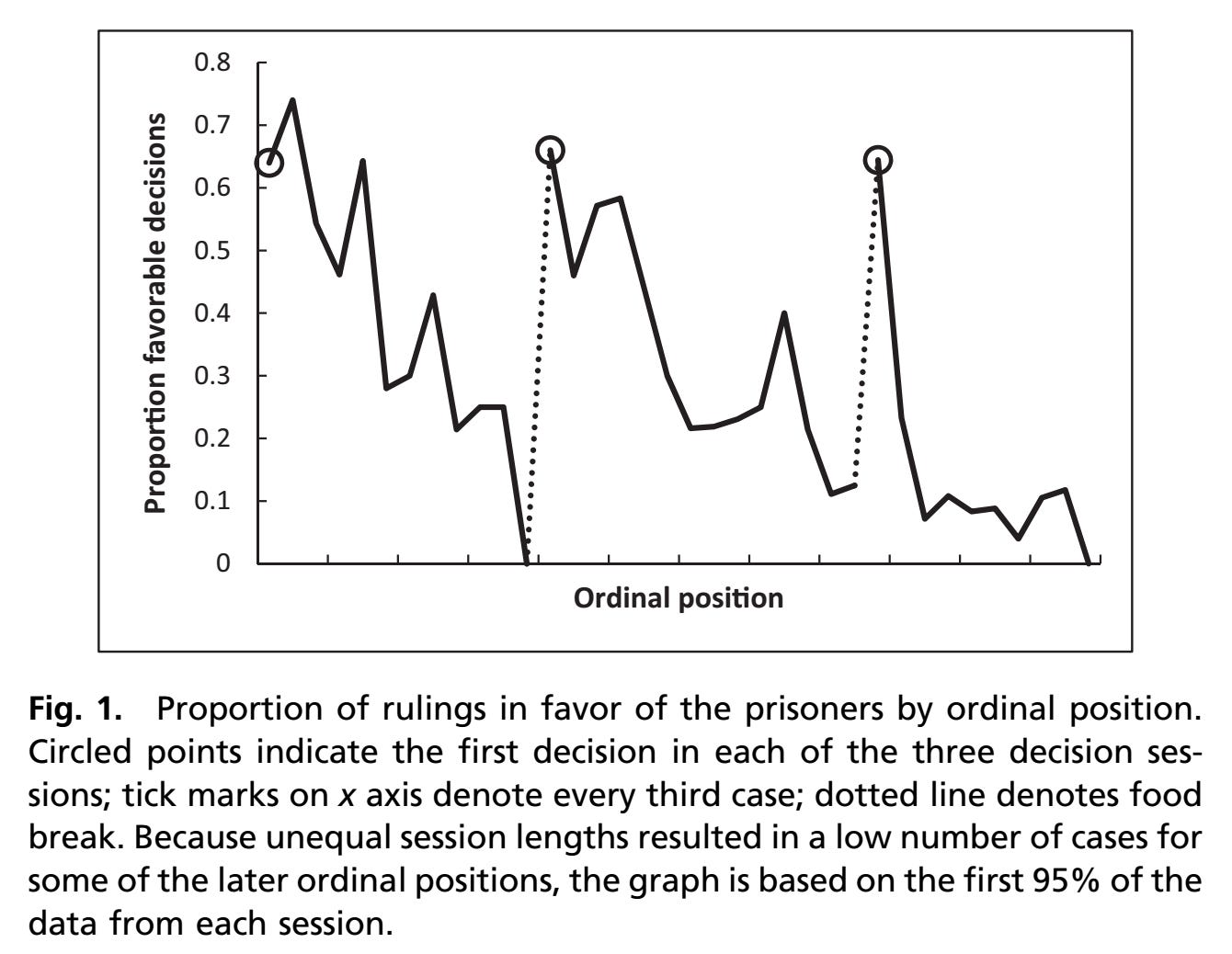
This finding has been criticized repeatedly and is broadly seen as a myth now. For one thing, the effect size is just too large to be at all plausible. As experimental psychologist Daniël Lakens put it:
If hunger had an effect on our mental resources of this magnitude, our society would fall into minor chaos every day at 11:45 a.m.
Like any too-good story, it turns out there’s a very simple alternative explanation: case orderings aren’t random. Those without representation are more likely to be interviewed closer to the end of a session, and are also less likely to be granted parole. In addition, simple decisions judges make about when to break for lunch could add to this effect—if favorable cases take longer, judges may be more likely to break instead of taking on a case more likely to end in parole, and this could explain the effect.
Similarly, there’s a whole literature on “priming” that claimed that our behavior is driven in radical ways by all sorts of subtle things in our environment without us knowing it—being reminded of old people makes us walk slower is the canonical example. These studies have not held up well, and the priming literature is now held up as a poster child for psychology’s replication crisis.
But there’s plenty more fodder that should make us question how reliable we are at understanding the causes of our own actions. For one thing, there’s plenty of evidence that we confabulate—we can make up explanations for why we did something, even when we haven’t.
In one famous study, people chose which of two female faces they found more attractive. After choosing, they were handed their picture and asked to explain their choice. The trick was, even if the picture they had rejected was given to them, they didn’t notice and came up with explanations for why they had chosen the picture they had actually rejected.
These sorts of lab experiments might not prove much—they’re testing choices that the participants don’t care much about, and tests have shown we’re not so easily fooled when we have stronger preferences. But it does show the limits of our insights into our own choices—why we do what we do, or even what we’ve chosen, isn’t transparently obvious to us.
More broadly, we have an introspection illusion where we wrongly think we have direct insight into our own mental states, not recognizing that any form of introspection necessarily relies on making inferences about the causes of our own actions.
Some have even argued, on evolutionary grounds, that we are systematically unaware of our own motivations in a way that makes us see ourselves as more admirable than we actually are. If we knew our own dastardly motivations, we couldn’t help but give away when we’re lying, so we engage in self-deception about our own motivations.
A human form of freedom
Regardless of the strength of these experiments, I suspect we’ve all had the experience of realizing, after the fact, that our actions were caused by something other than what we thought our intentions were at the time. Maybe snapping at a friend or romantic partner because, at the time, it felt like they were being annoying, but we realized afterwards we were just cranky because we were hungry.
Our feeling of conscious will is not an illusion, but a fallible inference about the causes of our actions. Generally we get it right, at least in broad strokes, but anyone with a reasonable level of self-awareness understands we’re wrong about our own motivations sometimes. Our conscious intentions are often a driving force in our decisions, but many more decisions are made automatically or unconsciously.
The interesting thing about seeing our feeling of conscious will as an inference is that it means that it may be more accurate if we have a better model of ourselves. Understanding human behavior generally and ourselves more specifically might allow us to more accurately tell when we’re fooling ourselves (cue the new agey self-help advice about getting connected with your true self).
But regardless of how good any individual is about knowing thyself, free will, defined as “being the causes of our action”, is not an illusion. Understanding neural mechanisms can only undermine free will if we make ourselves small and fail to recognize these mechanisms are a part of us. The first-person feeling of authorship can be wrong, because we’re in the familiar human position of having limited visibility into something (in this case, our own inner workings), and we can get it wrong. But fallibility doesn’t make it an illusion.
Tommy: as a Sapolsky-level determinist, I really appreciate this and agree with most of it. The world would be better if more people adopted your view.
My specific problem is with labeling our feelings of authorship / agency / conscious deliberation as "free will." (I understand the practical arguments for doing so.) That phrase, as commonly understood, necessarily implies a cause-less cause, a contra-causal freedom - something more than the laws of physics.
That is where the problems come in. Assuming, after the fact, that people could have done differently gives justification to "justice," blame, vengeance, retribution and retaliatory punishment, and the general sense of "just desert" / "people get what they deserve."
We can try to create the best possible system and incentives for learning so people can live their best possible life. But that doesn't mean people who "fall short" have "failed" and are "bad" and deserve to suffer.
Sapolsky-level determinism allows for teaching and incentives and protective judgment - actually a better, more realistic system, since we wouldn't base anything on "just use your willpower or you're a bad person."
At least as importantly, I think, hard determinism offers everyone compassion based on the simple fact that, given their genetics and environment, they couldn't have done otherwise at that moment.
In her book, The Things We Never Say, Elizabeth Stroudt’s main character Artie is obsessed with the question of free will. Later in his life, he will discover that his now adult son has a deep fascination with free will as well.
In his remarkably impactful guidebook, Contemplation, Richard Rudd notes that our “will” is actually found in both pausing and pivoting. The simple will to think about the outcome that would serve both us and others better — a crisp, clear way to tell us to Look Before We Leap. Free will is being willing to consider our impact and chose how we respond.