

In Defense of Learning Stuff
Knowing things is good, actually

I was shocked recently to learn that the talk show The View still exists. It's a daytime television program, a category I thought ceased to exist long ago in this age of streaming. The View has had a good run—more than 4000 episodes across 28 seasons and sports an impressive 2.4/10 rating on IMDb.
The only reason I know of the existence of The View is from a famous clip that made the rounds almost two decades ago now. In it, one of the hosts (Sherri Shepherd) is put on the spot by Whoopi Goldberg, who asks her the extremely difficult question: "Is the world flat?". This is how she answered:
Is the world flat? I don't know. I never thought about it. But I'll tell you what I've thought about: how I'm going to feed my child, how I'm going to take care of my family. Is the world flat, that has never been an important thing to me.
It was later clarified that yes, Sherri does believe the world is round. There's a charitable interpretation of what Sherri was trying to articulate—whether the earth is round or flat doesn't affect her everyday life, so it's not something she bothers to think about. It's an old dusty fact in the back of her mind.
In the same era, a clip circulated in which Neil deGrasse Tyson took Richard Dawkins to task on how hostile he can come across when communicating science. Dawkins accepted the rebuke but replied he wasn't the worst on that front—he quoted an unnamed editor who said his philosophy at New Scientist was:
Science is interesting, and if you don't agree you can fuck off.
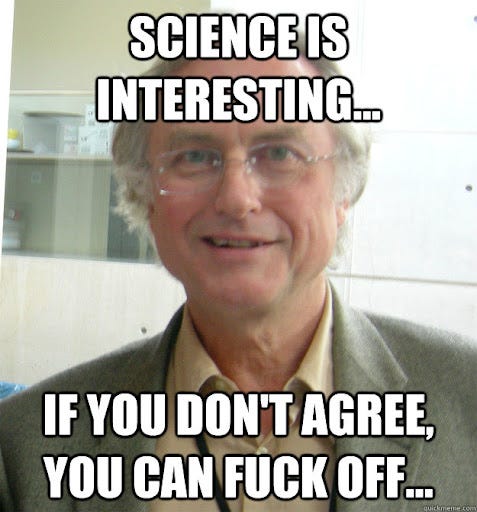
For Sherri, science isn't relevant to her practical problems, so she didn't see the value. For the editor Dawkins was quoting, you either are interested in science or you're not. Both quotes treat learning science as a matter of practicality or taste. Either you find these facts about the world neat and seek them out, or you don't.
I think this account of why some people are interested in science (and understanding stuff more generally) sucks. I think we can say more, and give the Sherris of the world a reason to care about whether the world is flat, instead of just telling them to "fuck off".
Just the facts, ma'am
Up through highschool, I hated science classes. Physics was fine because it was mostly just another math class. Chemistry was a mix of very easy math and some memorization. I avoided biology, though. Memorizing the organelles in a cell so I could label them on a quiz wasn't my idea of a good time.
I preferred math. It didn't require so much memorization—there was a logic to understanding the proof that there is no highest prime number. Once I understood the reasoning, I didn't have to memorize the proof—I just reproduced it from my deeper understanding of why there couldn't be a largest prime. The facts in biology and chemistry didn't have that same kind of necessary logic. Memorizing the periodic table or the names of organic molecules was just drudgery. It was all dry facts to be stored so I could regurgitate them on tests.
I occasionally read science magazines, but they were mostly filled with neat facts. They might be entertaining for a few minutes, but if I'm honest, I think the main reason I read them was because I wanted to be seen as a smart person who knew stuff about science.
I saw learning about science as equivalent to the memorization of facts. Mostly boring with occasional neat trivia tossed in. I felt similarly about history, where it was just all about the names of events and people and dates.
What I was failing to understand was how when you put together multiple facts—whether scientific or historic—you end up with more than just a bunch of facts. When you take history and learn the date of an event, you are adding more to your knowledge than just that stand-alone event. The date tells you when that event happened in relation to other events. The more other events you know about, the richer the relationship any given event has with the others. The people and factions involved, what other events were happening at the time, how similar events played out in other countries, how it affected laws or borders in the modern day—the more stuff you know, the more structured knowledge you have to contextualize a fact and make it more than just boring trivia.
The more you know, the more knowledge you have to relate to new knowledge.
Patricia Alexander, an education researcher, has a framework for the phases learners go through—the Model of Domain Learning. In the initial phase, when students don't know much about a domain, they're only interested in learning if their attention is drawn to something. A teacher can interest them in neat trivia facts. But they won't seek out new information in the domain on their own. For that, they need to get to the point where they have enough structured knowledge. Gaining that structured knowledge requires learning a bunch of facts—enough to give the learner an ability to abstract out the important patterns and relate new learnings to things they already know. Then, learning becomes fun, and learners seek it out on their own.
This aligns with the theories of George Loewenstein, a behavioral economist who has studied curiosity. According to Loewenstein, we feel curious when we recognize a gap in our knowledge. If you know nothing about biology, the name and functions of the organelles in a cell isn't a gap—you don't have enough of an understanding of life and what it needs to do to perceive a gap, it's just a wide-open field. Gaps require us to have some knowledge in an area first.
A good teacher can lead a student to gaps in their knowledge—pointing out that cells need energy, just like us humans, and need to get rid of waste, can give some context to the functions of the organelles in a cell. These are rough analogies and only go so far, since the world of cells is different in a lot of important ways from the world of us large multi-cellular animals. When you're starting out in a new domain, it's hard to avoid some amount of brute memorization, just to get the scaffolding up upon which future knowledge can be built (and gaps can be perceived).
Actual learning and understanding is about more than memorizing facts. It's about recognizing relationships and abstracting patterns. But to get to the point where we have enough raw materials to recognize the relationships and patterns, we often have to go through a painful period of accumulating facts without the benefit of a framework to contextualize them. This is why teaching and learning are hard.
Why Go Through The Trouble
We need to learn boring stuff for it not to be boring to learn stuff.
But why should we bother learning stuff? Why go through the hard part?
Learning that the Earth isn't flat or that it goes around the sun isn't interesting on its own. But when contextualized in various ways—when we understand the relationship between the orbit of the Earth and the seasons we experience, our planet's place in the galaxy and its relation to the stars we see at night, the size of our solar system and the size of the tallest man-made structure—these dry facts can take on new life.
It's these relationships with other things we know that makes us see the gaps which make us curious for more. It’s these same relationships that make facts come to life. The whole world can become more interesting as you see the deeper connections in the things we come across everyday. It also makes you more aware of the gaps in your knowledge, and that curiosity brings the world to life in a different way.
This isn't just about learning science—taking the time to learn a bit about various subjects can open your eyes to the gaps in your knowledge and make you feel alive with curiosity, and make you see new connections with things you didn't see before. Whether history, art, music, engineering, economics—all of these can change how you see some part of the world.
With science, there are examples of it all around us. You're surrounded by examples of biology, some of it microscopic, some of it furry critters in your backyard, and some of it is you. Once you gain enough knowledge to make the connections to the things in your life that you are familiar with, you can see it all in a new light.
So here's what I think we should say to the Sherris of the world: Science is interesting, and if you don't agree you should pull up a chair and let's talk about something and try to gain the structured knowledge to make it interesting.
Please hit the ❤️ “Like” button below if you enjoyed this post, it helps others find this article.
If you’re a Substack writer and have been enjoying Cognitive Wonderland, consider adding it to your recommendations. I really appreciate the support.
I don't think the initial learning of random facts is actually necessary, it's just how we've all been taught. There's a great description of how to actually contextualize facts for better learning in How Learning Works by Ambrose, Bridges, DiPietro, Lovett, and Norman. At the heart of it is why we need to know these facts. Understanding cells helps us understand things like what germs are, how we get sick and what our body does in response, how flowers and plants work and how they're different from animals, and a myriad of other things. Tying the facts into existing knowledge can be the job of the teacher and not entirely on the student. I think a lot of people don't like school or learning because they are left to find the patterns themselves rather than having that explicitly taught. Once they have something to attach this new knowledge to, they remember it better and want to know more.
I try to bring this attitude to anything I'm trying to explain. This and the general tendency for my husband and I to both love giving explanations is why our kiddo understood electricity conductance at 2 (he was scared of thunder), gravity at 3 (he got a scooter), and so many other concepts. They are grounded in his experience and have meaning, so he's also able to apply this knowledge to other things. We also use big words all the time, so he's not afraid of them and knows he can just ask what they mean.
I have certainly experienced the lack of basic understanding and factual knowledge when learning about new topics - the signal one for me was as a young anatomy student - the detail and memorisation was phenomenal initially and, personally, quite aversive. Later it became easier to learn as there was more to attach (slight pun) it to - bit like LEGO building bitd. I eventually enjoyed it. It had the added benefit of being relevant to many other topics when you had systematised and incorporated it into your general understanding of the world. Good thought provoking essay, thank you.