


One of my favorite passages of non-fiction is from the astronomer Carl Sagan, talking about an image taken in 1990 from Voyager 1 as it left the solar system. At a distance of 6.4 billion kilometers, the spacecraft turned its camera back, and took a picture of Earth. From that distance, our entire planet appears as nothing more than a pale blue dot.
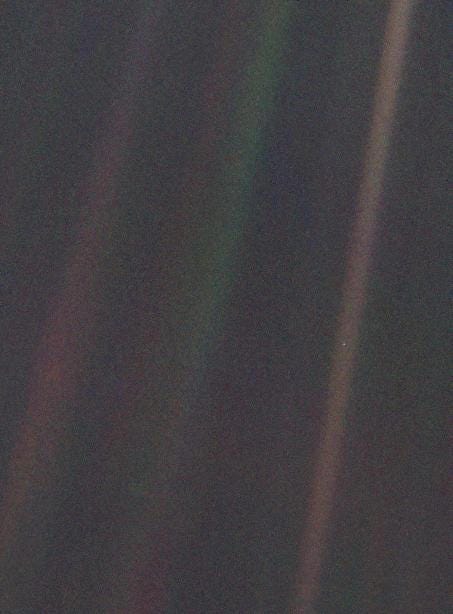
Look again at that dot. That’s here. That’s home. That’s us. On it everyone you love, everyone you know, everyone you ever heard of, every human being who ever was, lived out their lives. The aggregate of our joy and suffering, thousands of confident religions, ideologies, and economic doctrines, every hunter and forager, every hero and coward, every creator and destroyer of civilization, every king and peasant, every young couple in love, every mother and father, hopeful child, inventor and explorer, every teacher of morals, every corrupt politician, every “superstar,” every “supreme leader,” every saint and sinner in the history of our species lived there--on a mote of dust suspended in a sunbeam.
[...]
There is perhaps no better demonstration of the folly of human conceits than this distant image of our tiny world. To me, it underscores our responsibility to deal more kindly with one another, and to preserve and cherish the pale blue dot, the only home we’ve ever known.
—Carl Sagan
If you haven’t read the full passage before (or even if you have), I recommend you do. It’s only five paragraphs long. The passage evokes awe at the vastness of space, puts our human conflicts into cosmic perspective, and reminds us of the importance of our planet.
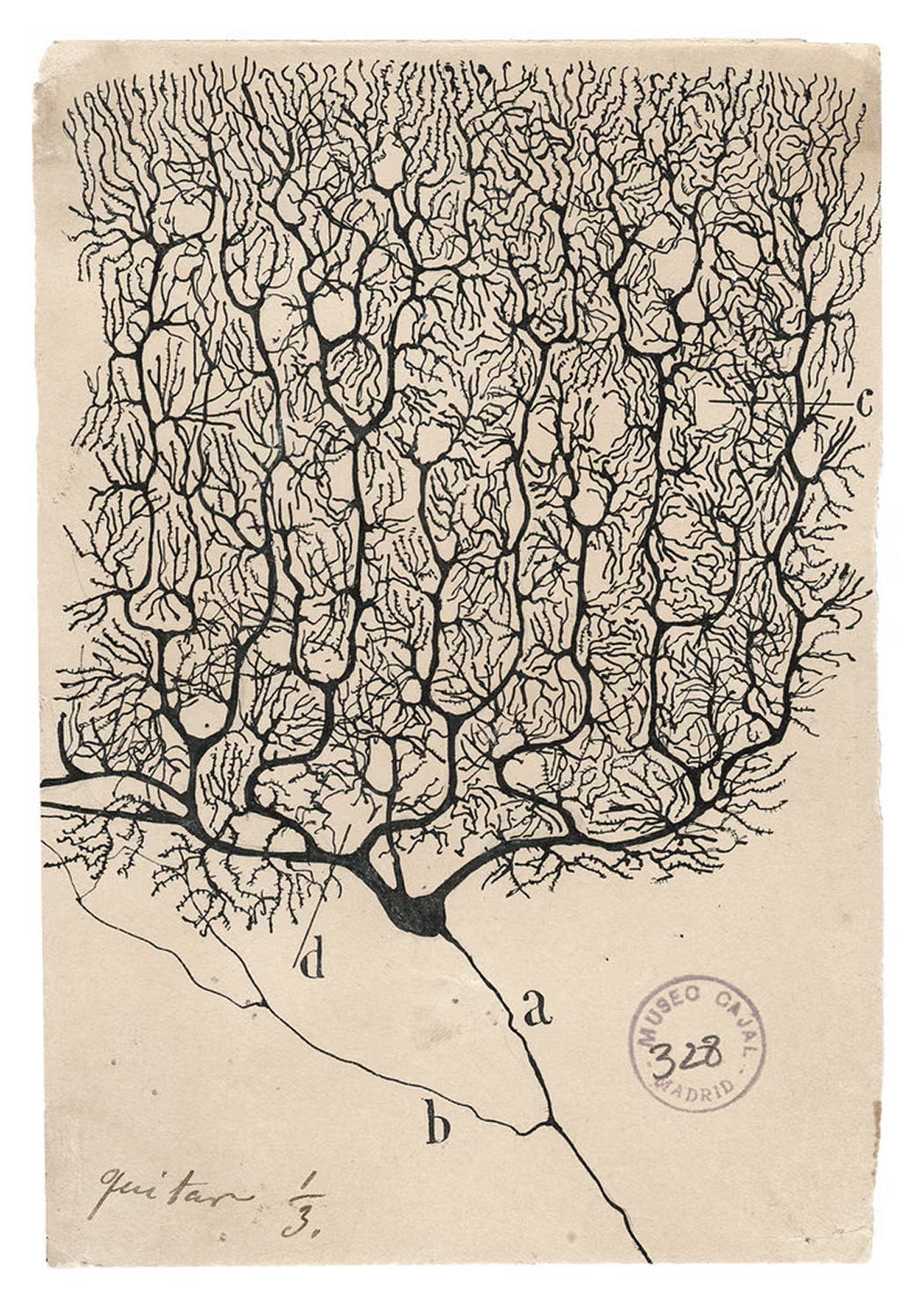
Over a hundred years prior to Voyager 1, Camillo Golgi and Santiago Ramón y Cajal started using a new staining method on slices of brain. The Golgi method, as it’s called, dyed only a few of the heavily packed brain cells, allowing individual neurons to be visualized with unprecedented levels of detail.
Here is how Cajal recounts seeing these cells for the first time:
Against a clear background stood black threadlets, some slender and smooth, some thick and thorny, in a pattern punctuated by small dense spots, stellate or fusiform. All was sharp as a sketch with Chinese ink on transparent Japan-paper. Dumbfounded, I could not take my eye from the microscope.
Cajal would go on to illustrate these “black threadlets” in thousands of pictures throughout his career. He and Golgi eventually shared the Nobel Prize for their neuroscientific work.

Images have long been important tools of discovery, but as Sagan’s writing shows, scientific images can have an impact far outside the confines of the lab. They can inspire awe and wonder, and give us an opportunity to reflect on some familiar piece of our world displayed in an unfamiliar way.
I wanted to try to capture some of this awe and wonder in a homage to Sagan’s Pale Blue Dot. Here it is.
Slender Black Threadlets
Look again at those threads. A single cell, branching out in a mazelike pattern, forming a dense thicket. That’s the stuff of thought. Every notion, every memory, every feeling anyone has ever had was the activity of an interconnected web of cells like this. All of our joy and suffering, every grand idea or perfect plan, every feeling of love or hatred, every lesson learned or forgotten, every blunderous decision or brilliant insight, every itch or pain, taste, smell, or sound heard, every daydream, has taken place in a web like this—a dance of ions in a thicket of microscopic lace.
In these thickets lies everything that makes you you. Your beliefs and doubts, your taste in music, your memories. They grew, connection by connection, in this tangled web. The person you are is born of the shape this thicket settled into. Every person you pass on the street carries one of these in their skull, each shaped by a different life. And yet, nothing you could see with a microscope could tell you which thicket belonged to your best friend and which to your worst enemy.
It’s easy to feel we sit above the messy world of biology, that whatever we are is different from the world of animals. But in the skulls of pigeons and rabbits, we find the same dark threads. Every high-minded philosophy we have is the activity of tiny wet cells, the same sorts of membranes and ion channels you find in a jellyfish. We are made out of the same materials as the rocks and sea. Ordinary matter, arranged just so, thinks and feels and wonders what it is. We have no need to look beyond this world for enchantment.
These tangles of brain cells are the only kind of thing known so far to give rise to a mind. We’ve probed them, scanned them, sliced them, cultured them, and filled libraries with what we’ve found. Each brain has hundreds of billions of cells and trillions of connections, and no two are wired the same way. The complexity of these webs is what has allowed us to understand so much of our world, and that very same complexity keeps us from understanding the webs themselves.
It has been said that studying the brain takes the magic out of the mind. There’s no better response to this than the images of these threads. Thousands of generations of humans lived and died without knowing what thought was made of. Now we can see these slender threads that, when connected in unfathomably complex ways, allow us to think, love, and wonder. We are a thicket of threads looking back at itself, and we’ve only just begun to see what’s there.
If you enjoyed this, please hit the “Like” ❤️ button, restack, or share this article to help others find it.
If you enjoy Cognitive Wonderland, consider supporting it by becoming a paid subscriber at whatever level feels comfortable for you.
If you’re a Substack writer and have been enjoying Cognitive Wonderland, consider adding it to your recommendations. I really appreciate the support.
Superb. The universe and the brain seem infinite
It is truly amazing to think of, and you didn't even discuss the biochemistry of the brain, including hudreds of neurotransmitters that allow these threadlets to function!