

The Self as Brain
Getting Traction on Consciousness, The Excitement and Wonder of Understanding the Brain, and the Neuroscience of Homosexuality, inspired by Touching a Nerve by Patricia Churchland

The human brain is made out of around 86 billion neurons and roughly 100 trillion synaptic connections. It’s a staggeringly complex organ, and neuroscience is a relatively young science.
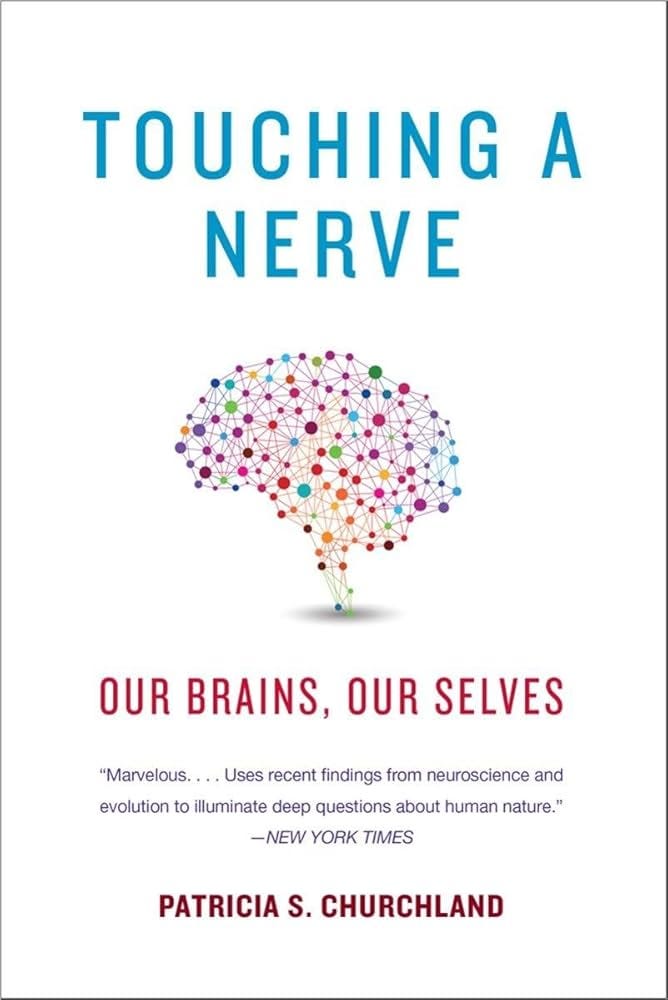
But given our modern understanding of the brain, what does it really mean to say that we are our brain? This is the question Patricia Churchland attempts to answer in her book, Touching a Nerve.
Churchland captures some of the excitement and wonder I myself have about the difficulty and the thrill of understanding the brain. We understand small pieces, mechanisms that explain how we’re able to do certain things. The weird thing is that these pieces are simultaneously intimately entangled with how we experience the world, yet seem foreign when we learn about them.
We know what it means to feel motivated to do something. Yet learning about the motivational pathways in the brain that contribute to this feeling can be disorienting. Dopaminergic signals in the midbrain encode how much better or worse an outcome was than expected, rewiring action-selection circuits in cortex and the basal ganglia and gradually reshaping what we feel drawn to do. It’s a story of an autonomous control loop—there’s no part where there’s a little person inside controlling things.
It’s disorienting to think that we ourselves are the ultimate autonomous control loop: a control system with no centralized controller, made out of parts that, when put together, give us the wondrous complexity of a human being.
Churchland uses the analogy of a map to get this across:
We understand, more or less, how I can read a road map. We do not understand nearly as well how I can be smart because my brain maps my inner and outer worlds, absent a separate me to read those maps. I want to know how all that world mapping and me mapping is done.
Maps without a map-reader, or control without a controller—this is what makes understanding the brain so hard to wrap our heads around (even though I guess our heads sort of are wrapped around our brains).
The scope of what Churchland aims to explain is large. Where do our values come from? She sketches how the same brain areas that evolved to guide us towards basic survival and reproductive needs were gradually repurposed to support social values such as caring about kin and cooperating with others. Pain and avoidance became about more than avoiding what harms us, but also about what harms those we care about. When combined with our problem solving abilities, cultural norms come into play, and eventually grew into the laws and ethical systems we have today.
Just as she encourages us to think of morality in naturalized terms of the brain and social norms, Churchland discusses free will in terms of self-control. She argues that “contracausal” free will, the idea that our decisions have no causes, isn’t really what laypeople mean when they say free will. Instead, she takes free will to consist in acting knowingly and intentionally. It’s our brain that allows us to inhibit impulses, exercise self-control, and act according to our intentions.
Overall, what we get is an outline of how to naturalize these different philosophical topics, and in broad strokes I’m very sympathetic to the sketch. But for my taste, the sketch was a bit too sketchy, and in the effort to cover a broad range of topics none were covered in enough detail to feel like I got more than a taste of her approach. If I were to recommend a Patricia Churchland book to someone, I would recommend Brainwise, a book that goes much deeper into traditional philosophical problems than Touching a Nerve.
Getting Traction on Consciousness
A common sentiment is that consciousness is intractable to study. By its very nature, it seems confined to the first-person—private, subjective, and completely unlike the neurons firing in my head. The idea that neuroscience attempts to describe this in the third person, in terms of neural processing and signals, can feel like a category mistake.
You can hear this viewpoint from certain philosophers who claim that neuroscience can only give neural correlates of consciousness, but can’t explain consciousness itself. These kinds of claims belie a naivete about how neuroscience works. Neuroscience doesn’t begin and end with what we can visualize using neuroimaging. It isn’t just seeing which brain areas light up in different conditions.
The language of neuroscience is far richer than that. We seek to answer what computations are being performed, what representations are used in those computations, and how they’re physically implemented in the brain. This is hard work that requires copious research at all levels—collecting data in animal models, neuroimaging in humans, sophisticated behavioral protocols to tease apart different functions, and careful theorizing and computational modeling to account for it all.
The question, then, is how we go about investigating consciousness. How do we get traction on this odd, slippery-seeming thing? Here, Churchland points to a range of cases where consciousness varies in systematic ways: brain differences between wakefulness and sleep, or more interestingly between wakefulness and sleep-walking; absence seizures, where people freeze up for a few seconds with no awareness and no recollection afterwards; blindsight, where people report not being able to see, but are able to make at least some visual discriminations; and attentional neglect, where people with damage to their thalamus are unaware of anything on one side of their body despite having intact vision.
Each of these gives us a contrast between similar sensory inputs or behavioral capacities, differing in whether conscious processing is taking place.
We can also use various behavioral protocols—Churchland discusses masking, where a word is presented quickly and then either masked by “XXXXX” immediately, or after a brief delay. If the word is masked immediately, the person reports no conscious awareness of the word. If it is masked after a delay, the person consciously sees the word and then “XXXXX”. There are various other clever behavioral methods for studying conscious experiences in similar ways.
The point is, each of these states and behavioral methods give us a little leverage for studying consciousness. We can ask with each one, not just what different areas light up, but combine it with the different behaviors in each case to theorize about what different functions are being performed.
Churchland points to various pieces of evidence to motivate a tentative picture: the thalamus regulates activity in the prefrontal cortex, and connections across the prefrontal cortex allow it to synchronize. Thus, when the thalamus upregulates activity, causing “global ignition” across the prefrontal cortex, particular information becomes widespread throughout the network and available for a wide variety of other brain functions such as planning, deciding, and acting.
Churchland is the first to admit that this is a rough idea, not a robust theory. But ideas like this open up fruitful paths for further work. As our blurry picture of what we mean by consciousness becomes crisper, it opens up new research directions. It’s not clear what the right picture is currently, but it is clear we have plenty of places of traction for future research, rather than being stuck in the armchair pondering the mystery.
The neuroscience of homosexuality and going out too far on limbs
This last section is for paid subscribers, as a thank you for their support. If you would like to support Cognitive Wonderland or join our community, consider becoming a paid subscriber.
