


We all know the nerd stereotype: the smart kid who lacks any social skills or confidence. Bad at sports, bad at socializing, wears glasses, often short, and either too skinny or fat.

I fit the stereotype pretty well in high school. I was seen as one of the smart kids (despite never really excelling in class), was quiet, awkward both physically and socially, and while I wasn’t short (I’m 6’2) I certainly fit the skinny description (I weighed 145lbs, for a BMI just on the edge of the “underweight” category). I even had the glasses.
Given the ubiquity of the stereotype, you would think there was some inverse relationship between intelligence and social skills. As if the world needs to “even out” the traits it doles out—if you’re smart, it gets balanced by poor physical features and social skills.
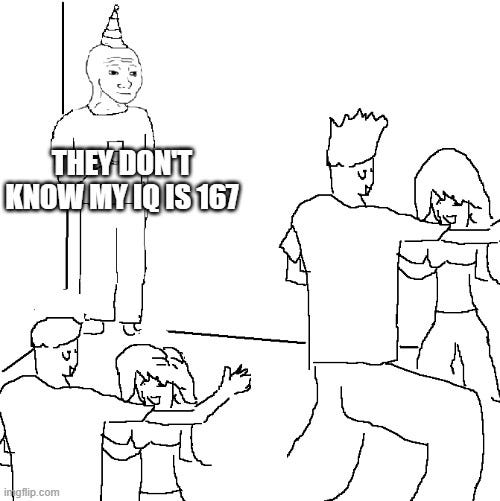
Or maybe it’s that the smarter you are, the harder it is to relate to the dummies around you. It’s easy to find this kind of sentiment on the internet, sometimes taken to an extreme. For example, here’s part of a post I found on reddit:
As the wisest among you may have already figured out, my torment partly stems from my absolutely humongous intelligence
My acute lucidity made me adopt a cynical stance and voluntarily seclude myself from others since a young age. You have no idea just how insufferably rotten, complacent, hypocritical and stupid you all are

The issue with this narrative is that, in reality, smart people don’t tend to be worse at socializing. They don’t tend to be more physically awkward, unattractive, or anything else undesirable—quite the opposite. Life is deeply unfair, but not in a way that justifies the nerd rage.
The Unfairness of Life
Here’s a deeply unsettling fact: a lot of traits we see as desirable tend to cluster together. IQ and tallness are correlated, and both are also correlated with higher incomes and attractiveness. It’s no surprise that there is a positive relationship between intelligence and happiness, even after controlling for factors like income.
Obviously there are counter-examples to these general trends—the correlations aren’t terribly strong, so there are going to be lots of short smart people and attractive people with low incomes. But the fact remains that these traits are positively related to each other. If you are high on one, you are more likely to be high on the others.
Not only are smart folks likelier to be good-looking, tall, and high-earning, they also, contrary to popular narratives, tend to be better at understanding people—they’re better at recognizing the emotions of others, and the relationship between general intelligence and emotional intelligence is so strong some researchers have suggested emotional intelligence should just be considered part of general intelligence.
This isn’t just some abstraction that smart folks are better at this stuff but can’t put it into practice, either—smart people also tend to be liked more by their peers.
This is all a bit uncomfortable. We all know people who seem unfairly endowed with every positive trait imaginable (but we might not feel jealousy because they’re also so damn likeable). But again, these are weak associations, so any given person is more likely to be a mix of high, low, and middling scores across these traits. I’m not claiming every smart person is a giga-chad, just saying the narrative that smartness makes you less popular just isn’t empirically true, and if anything, it’s the opposite.
“Too Smart” for the Normies
The above is all well and good for the smart folks, but the nerd stereotype isn’t just that smart people are unpopular, it’s also about their preferences: they’re shy and have weird interests that make it hard for them to relate to others.
The evidence here is a bit more mixed. There’s no relationship between extraversion and general intelligence. But smart kids tend to be more selective about who they like, and among the extremely intelligent there’s a negative relationship between life satisfaction and time spent with others. This latter finding isn’t necessarily causal (it could be that smart folks with a less satisfying life seek out others more), but it is odd that this relationship doesn’t hold for those who aren’t “extremely intelligent”.
Regardless, these are far from showing the intelligent can’t enjoy being with others. For one thing, if intelligent people are more likeable, they can just afford to be more selective in who they spend their time with and when. More importantly, the effects are pretty weak.
I’m not a big fan of pointing to anecdotes, but it’s worth pointing out that it isn’t like the world-class intellects are uniformly unable to stand the rest of us dummies.
It’s sometimes claimed that John von Neumann was the smartest man who ever lived (although some of the more colorful claims about his intellect are overstated). He certainly has a lot of accomplishments to brag about—the von Neumann architecture of computers is used by nearly all modern computers; he established game theory as a field of study; formalized quantum mechanics; and made various other foundational contributions to set theory, automata theory, economic modeling of growth, and the Manhattan Project.
His thoughts were considered so valuable that in 1947 the RAND corporation paid him $200 a month (over $2,500 in today’s dollars) to just think about their problems during the time he spent shaving.
Despite his towering intellect, John von Neumann was famously gregarious. He threw parties regularly, enjoyed the company of others, and was generally regarded as having a warm personality. This is not a man who felt tortured by his “humongous intellect”.
Richard Feynman, winner of the Nobel Prize in Physics, was a similarly social genius. He famously spent evenings in bars and learned drawing and drumming from regular folks. If anything, the criticisms of Feynman are that he liked people a little too much—as a professor, he would apparently pretend to be an undergraduate to sleep with female students. He might not have been a great guy in some ways, but I don’t think it can be claimed his intelligence made him find regular folks intolerable.
The point is, if even some of the world-class smartest people enjoy being around “normies”, I don’t think anyone can legitimately claim they’re just too smart to find companionship. I think something else is going on.
If you’re so smart, why haven’t you learned to socialize
When I was 16, I was diagnosed with depression.
Skinny, nerdy, unathletic, and socially awkward, I was really the stereotype of a sad, frustrated geek.
I started seeing a mental health counselor. I think I had assumed a mental health professional would be able to talk to me and sort of figure it all out. Untangle my brain, tell me what all my problems were, and just instruct me on exactly what I needed to do.
That’s not what happened. I didn’t get much of anything out of the counselor, except the realization that if I wanted to feel better it was up to me. There wasn’t some magical expert who would be able to look me up and down and tell me exactly what I needed to do to be my best self.
I’m lucky that my depression wasn’t too serious—I wasn’t bedridden or having trouble with completing schoolwork. I could still motivate myself to do things.
I remember learning that one of the best things for depression was socializing. This was fucking annoying. The whole reason I didn’t socialize with my classmates was because I was smarter and didn’t share their stupid interests! But also… because I was bad at it. I was awkward in conversations with peers, didn’t know what to talk about, and gave nervous responses. It was easier to give in to my internal misanthrope than to try to like others.
So one day I decided that fine, fuck it, I guess I have to learn some goddamn social skills. I made a resolution to work on my people skills and try to interact more.
Much to my chagrin, it seemed to work. I wasn’t exactly Mr. Popularity, but in my last couple of years of high school I had more peers that I had positive relationships with. I was also happier. In undergrad, I even was the leader of various clubs—including the atheist club and the tea club. Clearly I was still a nerd, but at least it was a kind of social nerdiness.
Nowadays, I’m certainly still sometimes awkward. My lack of interest in sports and fascination with reading philosophy and science books doesn’t help me connect with the average Joe. But I also have no problem striking up conversations with people I don’t know, making friends in bars, or getting the phone numbers of women (by which I mean women who are moms, for the purposes of setting up playdates for my kids—I’m a happily married man).
I guess my point is, it’s easy to get into a sort of defensive posture about one’s lack of social skills—rationalizing it as caused by one’s superiority, looking down on others, etc. But if John von Neumann wasn’t too smart to joyfully interact with others, you aren’t either.
Surprisingly, there actually does seem to be evidence that social skills can be learned. Most of the evidence comes from studies of people with autism, but there have been a couple of studies on the general public that show positive results too.
Intelligence doesn’t make one an anti-social dweeb, and for those of us not gifted with a natural inclination towards socialization, a little bit of effort put into learning might go a long way.
Please hit the ❤️ “Like” button below if you enjoyed this post, it helps others find this article.
📚 Join the Cognitive Wonderland book club to read and discuss cool books on science and philosophy with us. 📚
If you’re a Substack writer and have been enjoying Cognitive Wonderland, consider adding it to your recommendations. I really appreciate the support.
That's what I've learned about "spectrum-y" kids. They may not catch on to things intuitively, but they're smart enough to figure things out at an intellectual level and get along just fine. Years ago, I had to explain to my five year old, who was annoyed and didn't understand why he needed to say "please" and "thank you," that society was like a machine with gears and that those words (and manners, generally) were like oil that helped it to run smoothly. It clicked, and he never had trouble saying those words again!
This is such an honest, necessary reflection, and I appreciate the way it dismantles the self-protective myth so many “smart, lonely” people cling to.
What struck me most is how gently but firmly you challenge the idea that intelligence excuses relational isolation. So often the “I’m too smart for them” narrative is really just a shield for embarrassment, fear, or old wounds. It’s easier to claim superiority than to admit vulnerability. But your story shows what most people never say out loud: loneliness isn’t a mark of brilliance; it’s often a sign of unhealed places we’ve convinced ourselves are personality traits.
Your honesty about depression at 16 really resonated. That moment when you realized no counselor, no book, no abstract intelligence could substitute for doing the slow, uncomfortable work of connection, that’s a turning point so many avoid. Choosing to socialize before you felt good at it, before you felt comfortable, before you felt like it fit you… that’s courage in its rawest form. And your life now reflects the fruit of that courage: not a sudden transformation, but a steady re-shaping of who you thought you had to be.
You also name something deeply important: the recognition that intelligence and social skill are not opposites. They can reinforce one another. And the examples you use: von Neumann, Feynman; remind us that brilliant minds are fully capable of warmth, connection, and playfulness. Isolation isn’t destiny; it’s pattern. And patterns can be unlearned.
But what moved me the most was the tenderness beneath your challenge:
If you’re lonely, it’s not because you’re above the world; it’s because you deserve the joy of belonging, and belonging takes practice.
Your words carry both truth and compassion. They invite people not to shame themselves, but to be honest about the gap between who they are and who they want to be, and to believe that their intelligence isn’t a prison, but a tool that can help them grow.
A beautiful, needed piece; and one that reminds us all that the mind can be brilliant, but the heart still needs company.
Blessings,
-Ze